
Curriculum Highlights
Cultivating 3-Literacy
- Students are immersed in an environment of English, Chinese and Information and Communication Technology.
- Students are encouraged to apply their languages and IT skills over a broad range of subjects.
Learn Through Authentic And Interactive Tasks
- Explore, discover and construct meaning through authentic problems.
- Projects and problems related to students' lives and the world around us.
- Project-based learning
- Problem-based learning
- Experiential learning for G1
Focus On The Learning Process
- Real-life Experiences
- Trial and Error
- Prediction
- Application
- Innovation
Seven Learning Goals
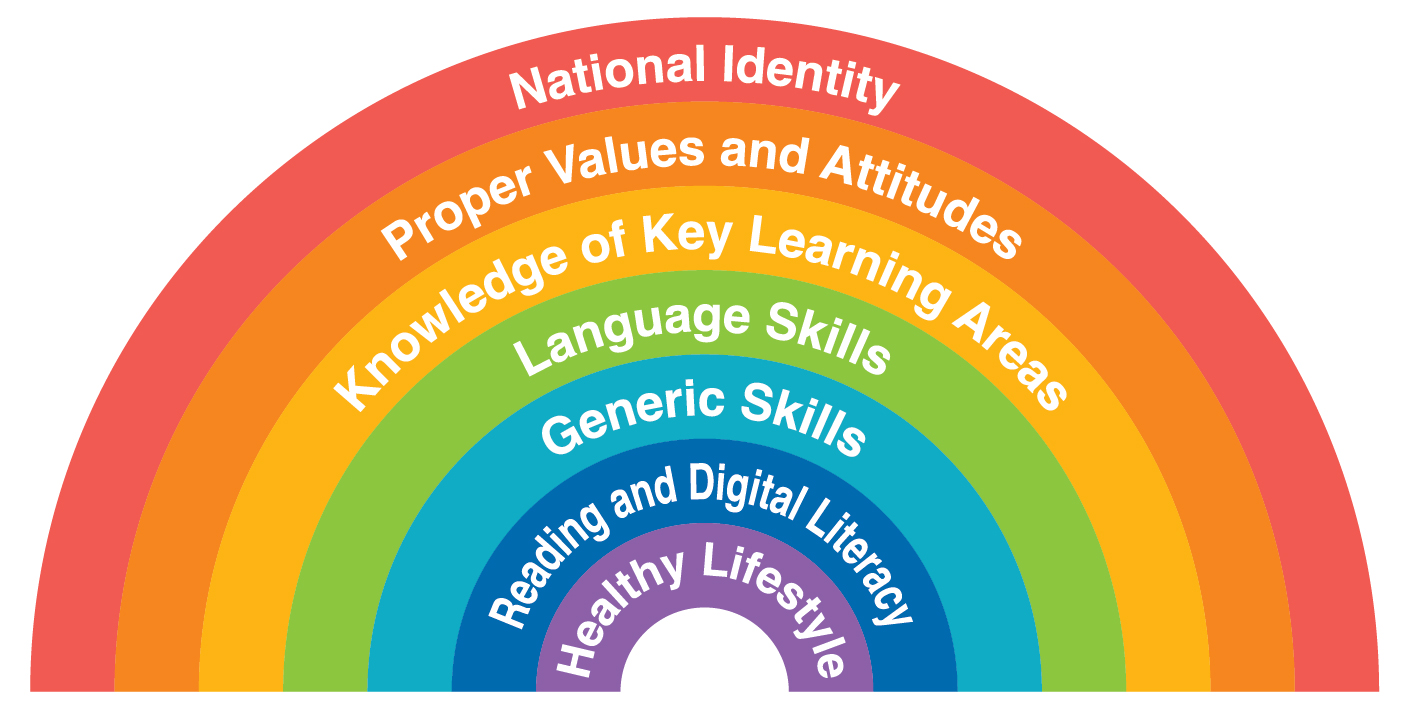
Seven Learning Goals of Primary Education (EDB, 2026)
Enhance Whole Person Development
- Liberal Arts
- Moral and Civic Education
- Life Education
- Social Service Groups
- Other Learning Experiences
- Uniform Group
- Leadership Training Programmes
- Sports & Aesthetic Development
- Reading to Learn
AI in Education
A-School follows the EDB’s 2026 Blueprint for Digital Education Development to bring age-appropriate AI-supported learning into classrooms and help students build future-ready digital skills. At the same time, our long-running Digital Citizenship Curriculum includes AI Ethics, guiding students to use technology responsibly, think about fairness and privacy, and make good choices online. We strive to help students grow as confident, thoughtful, and responsible digital learners.
Values Education
Our school adopts a clear, whole‑school approach to Values Education, guided by the EDB’s 2026 Values Education Curriculum Framework and strengthened through the PERCCI values—Perseverance, Empathy, Respect, Commitment, Creativity, Integrity. Across grade levels, students also learn age‑appropriate and specific Positive Values & Attitudes allocated to each grade, so students build strong character, strengthen relationships at home and school, and create a positive, respectful school environment. This structured progression helps to foster our students to grow into positive citizens.
Identify Students' Learning Needs
- Continuous formative assessments are carried out throughout the learning process in order to document students' growth.
- Mid-term (Term 2) and term-end (Term 1 and 2) summative assessments are carried out so as to provide teachers, students and parents a holistic review on students' learning progress.
- Assessment results will be analysed and evaluated for the teaching and learning process in order to increase the effectiveness of teaching and learning.
Cater To Individual Learning Needs
- Sports & Aesthetic Development
-Small group learning is arranged in English, Chinese and Mathematics lessons to lower student-teacher ratio, enhance interaction and encourage student participation. Students are arranged into groups according to their learning needs.
- Enhancement and Enrichment Programmes
-A-School encourages multi-dimensional development of students. Enrichment programmes are offered to provide challenges to students so they can deepen their learning and develop their interests.
-Through establishing the data bank for talented students, students may have opportunities to participate in gifted programmes offered by educational institutions like Math Olympiad, or school teams like Drama, Debate and Robotics.
-In OLE lessons, students can choose to participate in different courses to enrich their learning experiences.
-The school supports students with different educational needs by offering skills training groups and individual educational plan. The goal is to help students to reach basic competency in their learning and to build up an effective learning habit.
- Acceleration Programmes
-In acknowledgment of the diversity of students' abilities, acceleration programmes at A-School provide for educational flexibility. Curriculum content is provided earlier or at a faster pace to cater for the readiness, competencies and motivation of high-achieving students. Options provided include grade-skipping and subject-skipping.
-Students with a wide range of interests and abilities who are capable of performing at one or more grade levels beyond the current year will be considered for grade-skipping.
-Students who excel in a particular subject will have an opportunity for subject-skipping in order to enable them to learn content and work with peers who match their conventional performance.